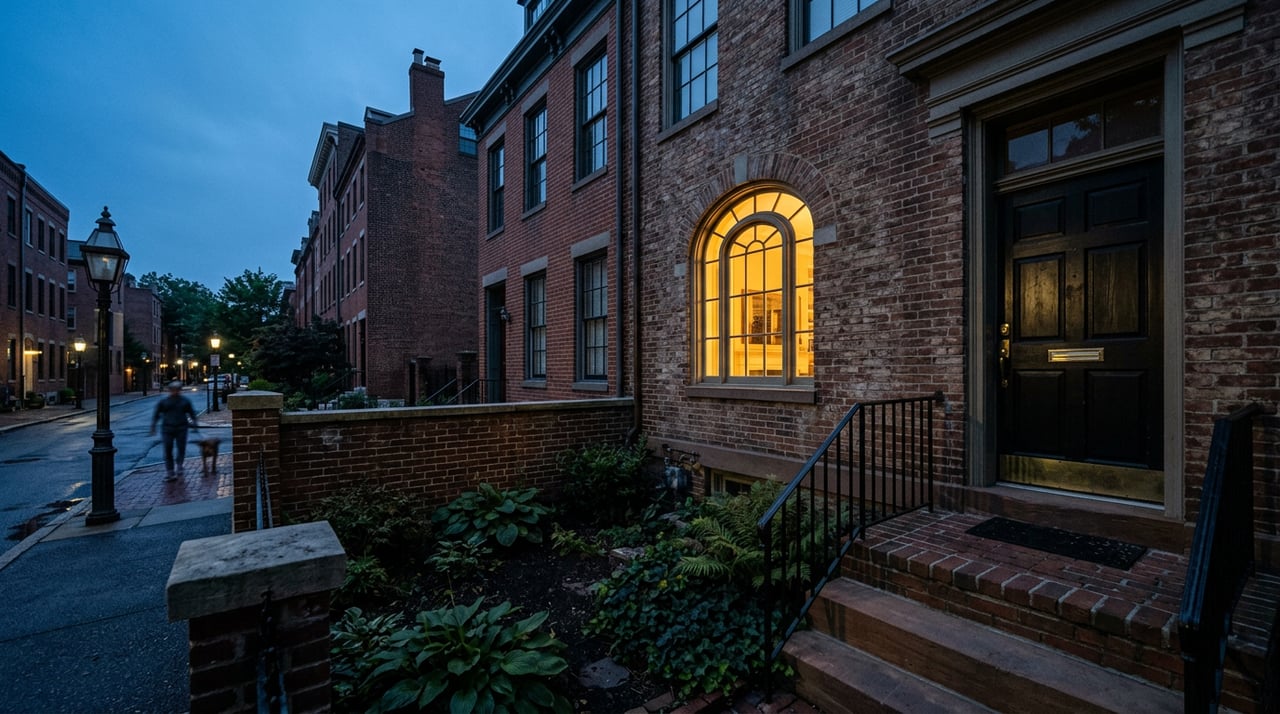
For years, three things reliably sent downtown Savannah residents out of downtown Savannah. Live jazz on a weeknight meant hoping the one bar that did it well hadn't closed, or driving to Hilton Head. A proper steak dinner meant a chain off I-95 or a hotel dining room that felt more like a stopover than a destination. And a walk along the river meant navigating century-old ballast stones and crumbling refuse bins; waterfront planning, meanwhile, dates back to roughly the Obama administration.
Somewhere in the last five months, all three of those complaints began to see answers within a few blocks of each other. The three changes arose from separate timelines: a lease, a business cycle, and a decade-old planning document happened to hit the same year.
The Jazz Room That Took Two Years to Replace
Good Times Jazz Bar closed and left a real hole. Local jazz icon Teddy Adams, who used to send visitors there because it was one of the few places in the city dedicated to live jazz, has talked about how people still call him asking if it's reopening. It isn't. The building sold, and the new owners never signaled plans to bring the format back.
What's replaced it sits about four blocks away at 111 W. Congress Street, in the former Órale Tacos space, right in front of the shuttered Lady & Sons. Nickel and Oak Lounge opened its doors on July 3 with outlaw country artist Nikki Lane headlining the grand opening, and it has been booking steadily ever since. By September the venue's calendar includes acts like Eric Jones and the Fabulous Equinox Orchestra, with a GA-20 blues show already on the books for late November.
The room seats around 165 and was built with acoustics as the point, not an afterthought. Architect Kevin Rose, who also handled the sound engineering, designed the space around a stage with a grand piano, a rooftop bar, and a private mezzanine. Owner Matthew Lipman, who also runs The Snug Irish Pub on Wilmington Island, brought in a team with real institutional memory: general manager Ava Pandiani spent seven years running Starland Yard, music director Isaac Smith has booked and mixed sound around Savannah for two decades, and events director Natasha Drena is the artistic director of Savannah Repertory Theatre. That's not a bar that got a piano. That's a venue built by people who already knew what this city was missing.
A Historic District Adds a Steakhouse, With Another on the Way
If you'd asked a downtown resident in 2025 where to get a serious steak without leaving the district, the honest answer was nowhere. Savannah, a city with more fine dining reputation than most cities its size, simply didn't have a dedicated steakhouse downtown.
That gap started to close in April. Marbled & Fin, from the Neighborhood Dining Group (the team behind Husk here in Savannah, with other locations in Charleston, Nashville, and Atlanta), opened April 8 at the corner of East Oglethorpe Avenue and Houston Street. The space runs 8,700 square feet across two floors, and Savannah Magazine reported that company president Kenny Lyons described the concept as a classic American steakhouse "but more modernized... less country-clubby wood-paneled walls and instead more chef driven." It's already proven itself in Charleston, and the company has put its Savannah hiring push at 650 jobs once the location is fully staffed.
The second arrival is Bull & Barrel Steakhouse, an import from Statesboro moving into a historic downtown building this year, filling floors that haven't held a full dining room in some time. A market that had essentially no steakhouse now has one, in a district where restaurant real estate rarely turns over that fast.
Congress Street Sees New Activity
The stretch of Congress Street just east of Whitaker has been what locals call a dead zone since Lady & Sons closed. Nickel and Oak filling that storefront isn't an isolated event. It's part of a broader pattern: the roughly dozen restaurants and bars opening in and around the Historic District this year aren't scattered randomly. They're concentrating in a narrow band of blocks that has gone dining-thin since the late 1990s.
Sela, a Spanish tapas concept from Daniel Reed Hospitality (the group behind Local, Public Kitchen and Bar, Franklin's, and Local 11ten), is landing at the intersection of Bull and Liberty, tightening an already dense pocket rather than opening new ground. That's good news if you live on that block and bad news if you were hoping for more geographic spread. But combined with the Congress Street activity and the Oglethorpe Avenue steakhouse corridor, the practical effect for someone living around Oglethorpe Square or Wright Square is a walkable dinner map that simply didn't exist a year ago. A two-story live-music room within four blocks of your front door changes what a Thursday night looks like without needing a car, and there wasn't a comparable venue between Broughton Street and the river before this year.
River Street's Waterfront Plan Gets Phase 1 Funding
River Street has had "vision plans" before. Studies in 2009 and 2017 both looked at what the corridor needed. The 2009 study eventually produced real results, including the completed Plant Riverside District and the grand stair at Montgomery Street connecting Franklin Square to the water. But plenty of ideas from those studies simply sat on shelves for lack of funding.
This time is structured differently. On June 25, 2026, Savannah's City Council approved a finalized Vision and Implementation Plan for the waterfront, covering 48 specific improvement points across the 12-acre River Street district, with the stated goal of making the corridor rival the world's greatest urban waterfronts. The plan is being administered by the Savannah's Waterfront Community Improvement District, a group formed in 2023 and led by executive director Julie Musselman, and it's funded through the hotel-motel tax the city adopted in 2019. District 2 Alderman Detric Leggett was blunt about where the money comes from: it's the tax paid by visitors, not by residents' everyday spending.
Along with adopting the plan, council awarded the district $1,350,000 to begin Phase 1: new ironwork marking ten access points onto River Street, accent lighting on the historic facades, and upgraded refuse enclosures on the ramps. $1.35 million is a small first bite of a project WTOC has put at roughly $60 million total, so nobody should expect River Street to look transformed by New Year's. What's different from 2009 and 2017 is that this plan has an actual appropriation attached to it, and the first physical work (the ironwork and lighting) is slated to start this year.
The corridor itself dates back further than most of the buildings around it. The Rousakis Riverfront Plaza that anchors River Street today was built between 1975 and 1977 for about $7.3 million, split between federal urban renewal funds and city money, replacing what had been a stretch of weeds, boulders, and decaying wharves that city leaders once considered paving into a parking lot. Whatever comes out of this new plan will be layered onto infrastructure that's now approaching its fiftieth year.
What This Actually Changes on a Given Week
None of these three threads were planned together. A restaurant group's lease timeline, a lounge owner's two-year build-out, and a municipal tax fund hitting a threshold for capital spending don't usually line up on purpose. But for someone who already lives in the Landmark Historic District, the coincidence still matters in a concrete way. As of this September, you can walk to a steakhouse and catch a blues or jazz act most weeks at a venue built by people who've actually run rooms like it before, while the first physical upgrades to River Street's entrances are slated to begin after nearly two decades of planning studies.
Whether the momentum holds is an open question. Restaurant openings concentrated this tightly can just as easily mean oversaturation on one or two blocks a year from now. And Phase 1 of the River Street plan is exactly that, a first phase, with additional points on that list and no announced timeline for most of them. But the pattern this year is different enough from the last decade that it's worth noticing while it's happening, not after the fact.
If you're curious how any of this touches property values or timing in the historic district, that's a longer conversation, and one I'm always glad to have. Reach out to Lisa Ortiz any time you want a local read on what's actually changing downtown versus what's just getting talked about. Let's Connect.